
My garden · site conditions
Soil and water in my garden in Bran
The ground beneath the flowers and the path water takes at 770 meters.
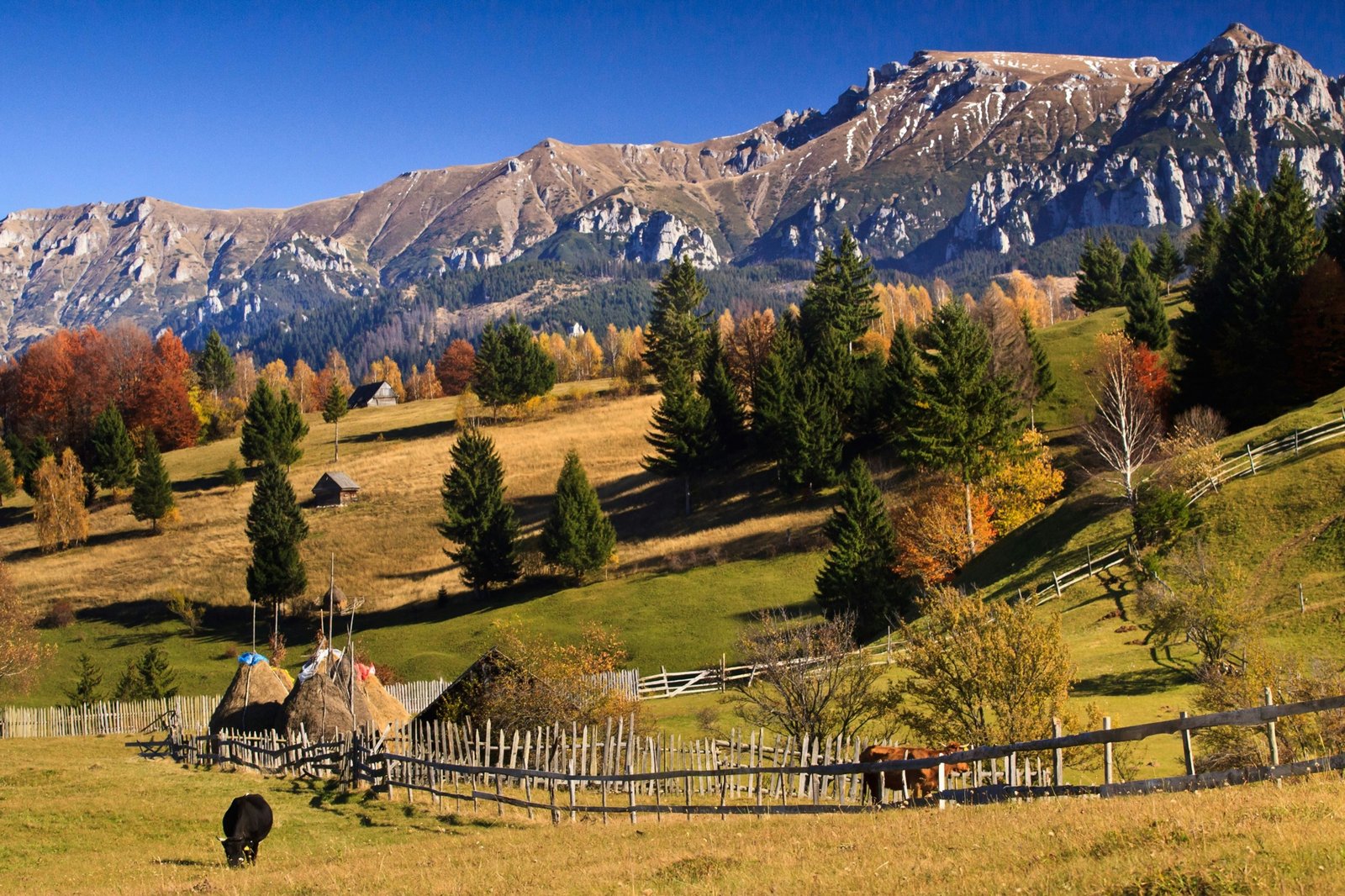
The sloping terrain makes the soil very different over short distances. Its depth, its ability to hold water and the room roots have to grow sometimes change within just a few meters. So I’ve come to see the garden not as one uniform surface but as a collection of small spots, each with its own conditions.
The differences become clearer after a long rain, when the snow melts or after a few dry days. That’s when I better understand why a plant grows naturally in one corner and struggles a little farther away. Books give me guidelines, but for my own yard I also need measurements.
When the spade hits rock
I was setting up a new corner of the garden when, after a hand’s depth of soil or so, I heard that familiar sound: metal on stone. I pulled out one piece, then another — angular fragments, light beige, some almost white. My first reaction was shock. Then came curiosity: what’s actually under my flowers’ roots?
Near Piatra Craiului, limestone plays an important role in shaping the landscape, but it’s not the only rock. The park’s documentation also describes sandstones, claystones, conglomerates and other formations. The look of the stones may suggest a limestone origin, but color and edges aren’t enough to identify them. A stone pulled out of the soil doesn’t prove I’ve reached the solid bedrock below. [1]
Roots can grow around a boulder; a slab of rock close to the surface limits their space much more. For me, the first useful piece of information is the actual depth of soil the plants have to work with.
What the regional soils tell me
In my research I came across names like brown soils, dystric cambisols and rendzinas. These describe soil types, not levels of quality. Rendzinas caught my attention because they’re associated with carbonate-rich materials, and the documentation of Piatra Craiului National Park mentions them on the limestone slopes. It’s a plausible hypothesis for some places in the region, but I can’t call the soil in my garden a “rendzina” just because it’s stony and shallow. Identifying it requires examining the soil profile and an expert’s interpretation. [2]
Nor do general pH, humus or nutrient values from a soil survey automatically become the values for my yard. Regional-scale maps don’t capture every bed, terrace or change in terrain within a garden. [3]
In some places the soil is sticky after rain, hard and sometimes cracked after dry spells. In others the layer is thin and dries out quickly. Stony soil isn’t necessarily poor, and dark soil isn’t automatically fertile. Depth, structure, organic matter and the roots’ access to water all matter together. Altitude alone doesn’t tell you the soil’s pH.
How the slope reshapes the path of water
Rainwater and snowmelt can run toward the bottom of the slope, carrying fine particles from bare surfaces. In my garden, the upper part dries out faster on hot days, while some low spots stay damp.
A slope doesn’t guarantee good drainage everywhere. Water can run off the surface and, at the same time, collect in a hollow or above a compacted layer. That’s why drought and waterlogging aren’t mutually exclusive: they can show up in different places, or even in the same place in different seasons. Moist soil and roots sitting in water for a long time are two different conditions. [4]
In fissured limestone terrain, water can move underground. The name of Sohodol, the village where I live, suggests a dry valley, and the karst terrain may explain why water isn’t always visible on the surface. For my garden this remains a possible explanation, not proof that every rain drains straight through the limestone.
How much rain the garden gets
I looked for reference points at Rucăr, on the Bran Plateau and at Fundata, but a similar altitude doesn’t make two weather stations equivalent. The orientation of the slopes, shelter and position relative to the mountains change how precipitation is distributed. The values below give regional context, not measurements for my yard.
| Location | Altitude | Annual precipitation |
|---|---|---|
| Rucăr | 700 m (2,300 ft) | 810.9 mm (31.9 in) |
| Bran Plateau (northern slopes) | 650–1,100 m (2,130–3,610 ft) | 650–850 mm (25.6–33.5 in) |
| Fundata | 1,370 m (4,495 ft) | 1,020.9 mm (40.2 in) |
What interests me most is the rhythm of the rain. The same monthly amount can arrive gradually or in a few downpours. The volume relationship is simple: 1 mm of precipitation means 1 liter of water per square meter. A 30 mm (1.2 in) rain brings 30 liters per square meter, but some of that water can run off beyond the root zone.
Snow stores some of the winter’s water and releases it as it melts. When the thaw is slow and the soil can take in the water, the supply is gradual. If the ground is frozen or already saturated, or the melt is fast, surface runoff can increase. Snow depth doesn’t translate directly, inch for inch, into an amount of water: its density varies.
What I can check at home and what needs a lab test
The vinegar test can give a hint about whether carbonates are present. Fizzing in a sample suggests free calcium carbonate, but how a stone reacts tells you something about that stone, not about all the soil. No visible reaction doesn’t prove the soil is acidic or neutral, and the test doesn’t measure pH. [5]
For pH and texture, the next step is a soil test kit or a lab analysis. In a garden with different zones, samples have to be chosen so the contrasts don’t get lost in a single mix. OSPA Brașov (the county soil and agrochemistry office) offers surveys and analyses, and a report can clarify pH, texture, organic matter and the nutrients included in the package you request. [6]
The water I use for watering
Right now I water the garden with water from the local mains. I haven’t had a soil or water test done yet, so I don’t assign my yard values published for other places. The first useful reference is the supplier’s report for the Sohodol–Bran supply area; if plants show persistent problems, a water test can clarify hardness, pH, alkalinity and the relevant salts.
Hardness, pH and alkalinity are different things. Hardness mainly reflects dissolved calcium and magnesium. Alkalinity shows the water’s capacity to neutralize acids, and it matters for how repeated watering can affect the pH of potting mix, especially in containers. A high pH alone doesn’t tell you how high the water’s alkalinity is. [7]
In acid-loving plants, unsuitable pH can limit the availability of iron and contribute to chlorosis. Still, leaves can turn yellow for many reasons, so I don’t blame the symptom on limestone without checking the other causes too. [5]
How much water I could collect from the roof
Rainwater usually contains few dissolved salts and can be useful for plants sensitive to alkaline water. For an estimate, I multiply the precipitation in millimeters by the horizontal roof area connected to the tank. For example, 20 mm of rain on 100 m² means 2,000 liters in theory; at a hypothetical efficiency of 80–90%, about 1,600–1,800 liters (roughly 420–475 gallons) might remain, limited in practice by the tank’s capacity. [8]
A simple system needs a stable tank, a lid, a debris filter and an overflow directed to a suitable spot. The water’s composition also depends on the roof and on storage; I don’t assume it’s sterile or the same from one rain to the next.
What all this means for plants
If testing confirms a limy soil, the list of possible plants is still long. Dianthus, certain campanulas, many species of Geranium (cranesbill), achillea and nepeta can be starting points. But the choice depends on the species, the variety, the light, the soil depth and hardiness to the winters here. [9]
Echinacea can grow in soils with different pH; it doesn’t need exclusively alkaline soil. Light and drainage still matter. Nor should hosta or astilbe be declared incompatible with every limy soil: in a shallow, dry bed, lack of water may be the main problem. [10, 11]
Rhododendrons, azaleas and other acid-loving plants are hard to keep directly in lime-rich soil. There can be solutions in containers with the right mix and water, if the species can also handle the local climate. I don’t try to acidify the whole garden for a few plants.
How I adapt my care
In areas with little soil, I can increase the usable depth with built-up beds of suitable soil and mature compost. I don’t pile it around the base of trees, and I don’t use pure compost as a one-size-fits-all solution.
I match watering to the species and to the actual moisture in the soil. When the terrain allows, a slow watering, enough for the root zone, is more useful than repeatedly sprinkling the surface. On a slope, it may take several rounds so the water soaks in before it runs off. Containers, seedlings and newly planted plants have different needs than well-rooted shrubs. [11]
Mulch helps hold in moisture. For many beds, an organic layer of about 5–7.5 cm (2–3 in) is a useful guideline, with space left around stems and crowns. The material and thickness are adapted to the plants and the spot. [12]
What I still want to learn about my garden
I want to get to know every corner of the garden better, not make the terrain uniform. Notes recorded at the same points are useful to me: the depth to an obstacle, the moisture after rain, how long water stands and how the soil dries out. Along with them, rainfall measurements and soil and water tests will make the picture clearer.
Things to measure: soil depth in several areas; pH and test results; the parameters of the local mains water; the roof area available for collection; rainfall and the dates of observations.
The stones that stopped my digging ended up opening a more useful question than the one I started with: how much room do the roots have, and how much water is left for them?
Sources and further reading
- Piatra Craiului National Park Administration — Geology.
- Piatra Craiului National Park Management Plan, section on soils.
- ICPA (National Research Institute for Soil Science) — ADER Report 12.2.1.
- RHS — Waterlogging and flooding.
- RHS — Soil pH and testing soil.
- OSPA Brașov — activities and testing services.
- Penn State Extension — Interpreting Irrigation Water Tests.
- RHS — Collecting, storing and reusing water.
- RHS — Plants for chalky soils.
- RHS — Echinacea.
- RHS — Watering plants wisely.
- RHS — Mulches and mulching.