
Herbs in the mountains
The ones that come back on their own and the ones I start again every year
In my garden, herbs fall into two categories: the ones that come back on their own every spring and the ones I call back myself. But this split hides more than it shows: not all of them want the same soil, the same water or the same patience.
They make room for themselves among the other plants without asking for attention. Some stand out for their foliage, others for their flowers, and many keep their scent for whoever touches them: a leaf crushed between your fingers says more than any label. And of everything in the garden, they’re the part that most easily crosses the kitchen threshold.
What the mountains ask for
In Bran, in Romania’s Brașov County, spring comes in steps. Frost comes back after you thought it had gone, and nights stay cold long after the days have warmed up. Summer is short, so every week gained at the start counts.
In winter, standing water puts sage, thyme and French tarragon to the test. I look for well-drained spots for them, especially where snow is slow to melt. [2] [5] [6]
The perennials that come back
Mint, thyme, lemon balm, sage, lovage and tarragon make up the core of my herbs. In winter, some retreat into the ground, others keep their woody stems and a few leaves, and in spring I find them in the same spot.
Lovage doesn’t know how to be small and needs a spot of its own, not just a narrow gap between neighbors.
The thyme in my garden is Thymus serpyllum, a low perennial with stems that spread along the ground. In Romanian cooking, “cimbru” usually means something else: summer savory, Satureja hortensis, an annual, the one that goes into sarmale (stuffed cabbage rolls) and bean dip. Their flavors are related; the way they live isn’t.
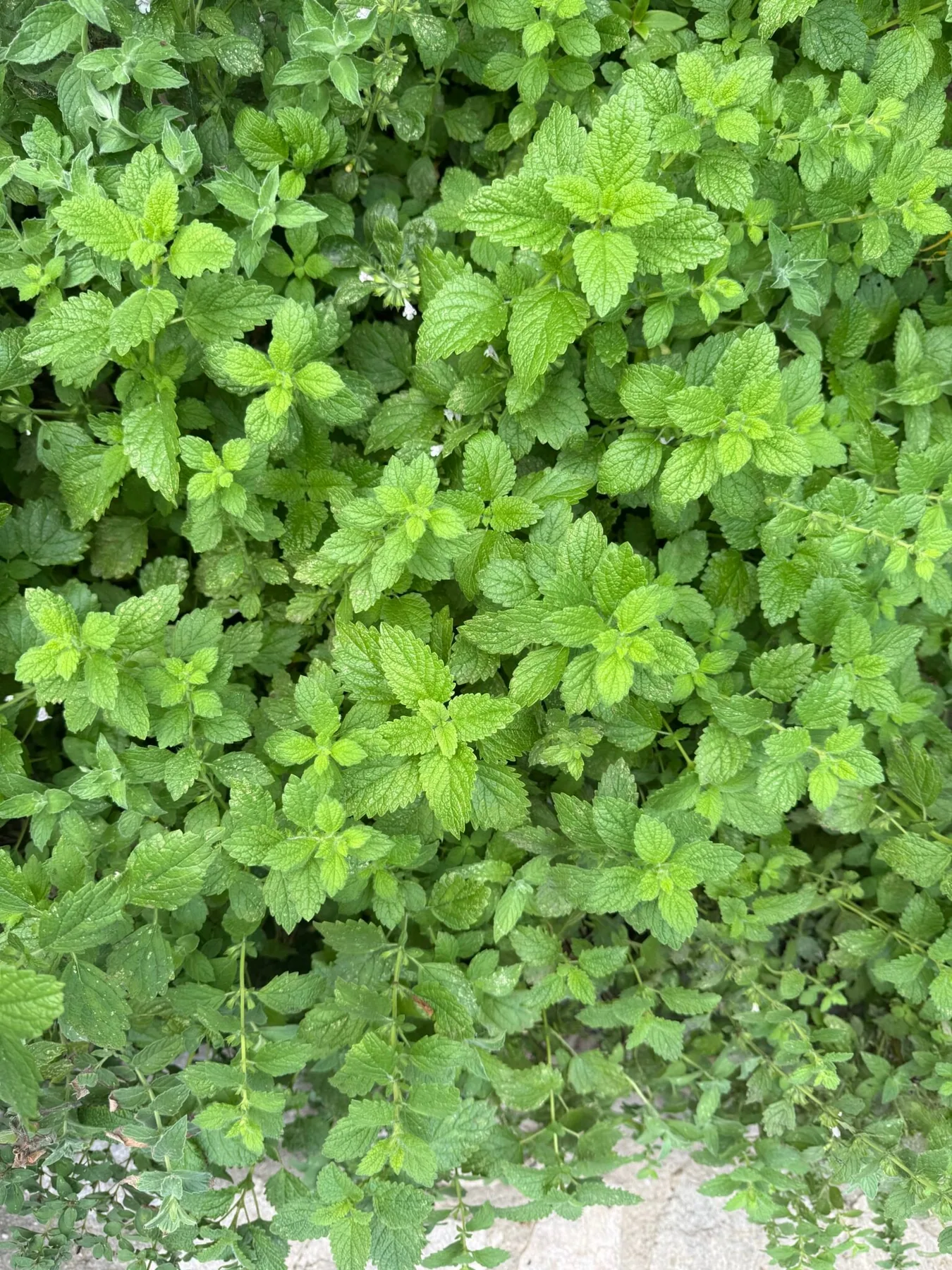
Savory isn’t the only one hiding two plants under the same name. By lemon balm I mean Melissa officinalis, which in Romanian is sometimes also called lămâiță. But lămâiță is also the name of Aloysia citrodora (lemon verbena), another lemon-scented plant, which I don’t count as a reliable perennial for Bran’s winters. [1]
The Romanian name for lemon balm, roiniță, comes from roi, a swarm. It’s a bee plant, and beekeepers used it to attract swarms. Its Latin name says the same thing: melissa means bee in Greek. Two languages, centuries apart, saw the same bees in the same plant.
Care doesn’t follow a single rule. Mint and lemon balm can be divided when the clump gets too big. Creeping thyme (Thymus serpyllum) can be propagated by dividing rooted sections, in spring or fall. Sage is trimmed lightly, in the leafy part; I avoid cutting deep into old wood. [1] [2] [6]
Tarragon
With tarragon, the label matters more than with any other herb. Two fairly different plants are sold under the same name, Artemisia dracunculus. [5]
French tarragon is smaller and finer, with thin leaves and a warm flavor with a hint of anise. It hardly sets seed, so it’s propagated from the plant: by division in spring or by cuttings in summer. Wet winters can easily finish it off; in a pot, moved under cover for winter, it has the best chance of surviving. [5]
Russian tarragon is taller, more vigorous and usually gets through winters without trouble, as long as the soil doesn’t stay waterlogged. It can also be started from seed, but its flavor is grassier, with a slight bitterness. [5]
Tarragon, especially the French kind, is a short-lived perennial, and a clump divided every few years stays young and generous. The top growth dies back after the first hard frosts; in spring, last year’s debris is cut back to the new shoots at the base. [5]
That’s why, when someone tells me tarragon “won’t grow” in the mountains, my first question is: which tarragon? Without knowing which plant I’m looking at, I wouldn’t turn experience with one type into a rule for both.
And the effort is worth it. In Transylvania, tarragon isn’t a French curiosity but the taste of Sunday soups.
The ones I call back from seed
I grow parsley, basil and dill for their fresh leaves and start them again every year. Parsley is actually biennial: in the first year it makes leaves, in the second it flowers and sets seed. For the kitchen, the first, leafy year is the one that counts. [3]
For me, sowing directly in the bed has rarely worked well, so I start the seedlings indoors from late winter. That way I give them a safer start, even when spring is unpredictable. Parsley calls for patience: it germinates slowly, and sometimes a two-week wait is normal. [3]
Dill is the exception I handle with care, because it doesn’t like being moved. Direct sowing after the soil has warmed is usually recommended. Since direct sowing often fails for me, I start it in cell trays and move it 2–3 weeks after it comes up, with the whole root ball, without disturbing the roots. A few small sowings a few weeks apart keep tender leaves on the table until fall. [4]
Basil is the last to leave the house. It’s not enough for the frost to have passed: it waits for warm nights, and in the mountains they come late. Until then, a bright windowsill and careful watering do it more good than rushing to move it into the bed.
Before moving out, seedlings need a few days of hardening off: outside during the day, under cover at night. Moved straight from the warmth of the house into the mountain air, they stop growing just when they should be taking off.
For all three, the first weeks outside are the riskiest, and not only because of the weather. Slugs reach the tender seedlings before I do, often in a single night. A big, well-rooted seedling loses a few leaves and carries on; one just moved out can disappear entirely. That’s why I put them out later and bigger than the guides say.
The right spot for each plant
Thyme and sage prefer sunny corners and soil that drains quickly. For them, wet soil in winter is a bigger obstacle than frost, and a slightly raised bed or a little gravel mixed into the soil can help.
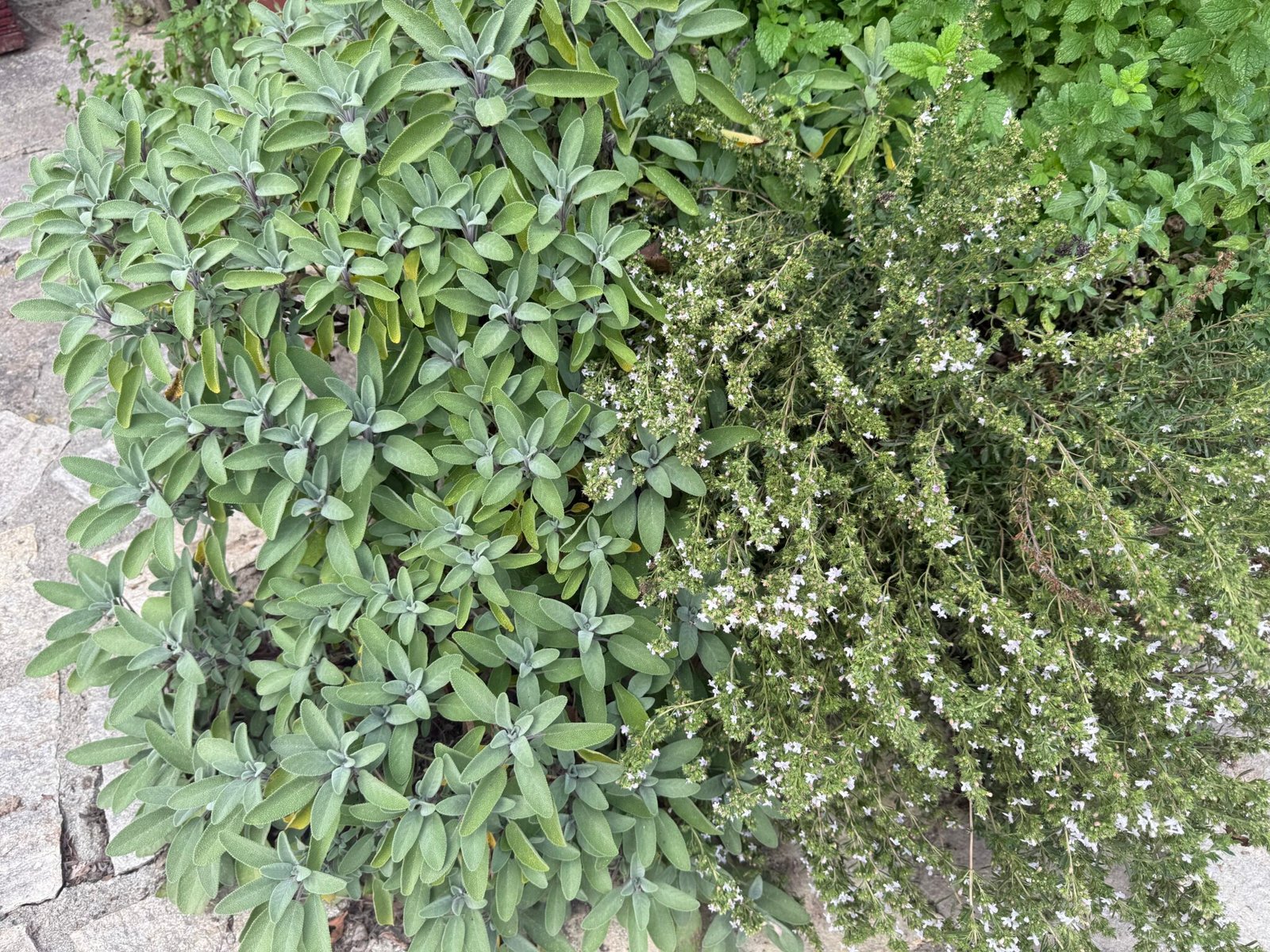
Mint and lemon balm do better in cooler spots, with moisture close at hand, but standing water doesn’t suit them either. [1] [2]
Mint doesn’t recognize borders. Left free, within a few years it ends up where I never invited it. A roomy pot or a corner where it can spread without crowding anyone is much easier to keep in check than a clump that has escaped among small plants.
Lemon balm has a different habit: it doesn’t run by its roots, but by its seeds. Cut back after flowering, it makes new leaves and doesn’t spread all over the garden. [1]
A harvest that lets the plant keep going
How much I harvest depends on the age and vigor of the plant. From a seedling that has just rooted I take only a few leaves, while a mature clump can give much more. Tips pinched often make the plant bushier and keep it young, and with tarragon and basil, buds removed in time extend the harvest. [5]
Not every species of sage is suitable for eating. In the kitchen I use Salvia officinalis, not its ornamental sisters from the flower beds, however nice their leaves smell.
From the garden to the pantry
The harvest doesn’t end with summer. Mint, lemon balm, thyme and sage dry well in small bunches hung in the shade, in an airy spot. Lemon balm loses some of its lemon scent but is still ideal for tea.
Parsley, dill and tarragon lose a lot of flavor when dried. Chopped and frozen in small portions, they’re ready to use even in midwinter. Fresh basil turns black in the cold; preserved in oil or as pesto, it keeps much better. [5]
❦
Every herb has its own rhythm. What matters to me is finding each one the right spot and gradually understanding how much it can give me without my asking too much of it.
At a glance: the herb chart
| Plant | Life cycle | Spot | Water | Keep in mind |
|---|---|---|---|---|
| Mint | perennial | cool, part shade | steady, no standing water | spreads; pot or contained spot |
| Lemon balm (Melissa officinalis) | perennial | sun or part shade | moderate | spreads by seed; cut back after flowering |
| Creeping thyme (Thymus serpyllum) | creeping perennial | sun, good drainage | little | light trimming; divide rooted sections |
| Sage (Salvia officinalis) | woody perennial | sun, good drainage | little | replace aging plants |
| Lovage | perennial | roomy, sun or part shade | steady | can grow as tall as a person |
| French tarragon | short-lived perennial | sun, sheltered, very good drainage | little | winter in a pot, under cover; propagated only from the plant |
| Russian tarragon | perennial | sun, good drainage | little | hardy; also grows from seed |
| Parsley | biennial, grown as an annual | sun or part shade | steady | germinates slowly |
| Dill | annual | sun | steady | dislikes transplanting; repeat sowings |
| Basil | annual, cold-sensitive | sun, warm and sheltered spot | moderate | outside only once nights have warmed |