
My garden · Bran, Brașov County, Romania · about 770 m (2,500 ft)
The garden’s microclimate: exposure and challenges
What I’ve learned about my garden at 770 meters
Set between the Bucegi Mountains and Piatra Craiului, my garden faces the whims of the weather every day. At this altitude, the climate is far from mild or steady, and it becomes a constant test of how well plants adapt.
It’s the kind of weather that quickly teaches you not to rely on the calendar alone, but on what you see and feel every morning when you step outside.
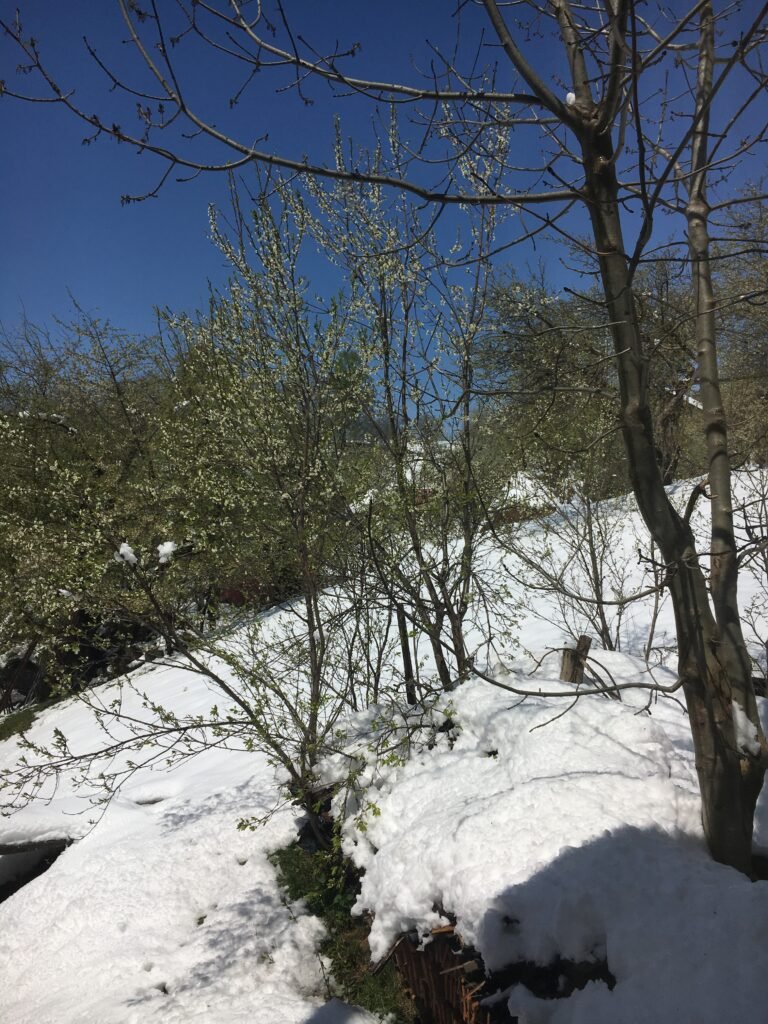
Sometimes, for a few days, you can walk around the yard and pass from one season into another. In one corner the ground starts to warm up, while in another snow still covers the spot where a shrub grows. Many of my choices start here: not only with which plant I like, but with the spot I can offer it.
Long winters and short summers
Winter sets in early and leaves late. Snow can linger in the shady areas until April, while on the sunny side of the yard the ground has already thawed days earlier. Summer is short and intense, and evenings can be cool even in July.
The whims of spring in the mountains
Spring arrives hesitantly, in deceptive waves. A week of warmth wakes the garden up, but an unexpected frost can quickly check the tender new growth. It’s a harsh rhythm, and I only understood it after my first losses in the garden.
That’s why I don’t move tender seedlings outside just because there have been a few sunny days, and I get them used to the outdoor air gradually. Wanting to see the garden get going doesn’t make the soil any warmer.
Wind changes where things go
The wind draws invisible maps across the garden. In corners exposed to gusts, tall plants need firm support, while in the shelter of a wall or fence the same flowers find their calm and grow quite differently. Wind dries plants out and snaps tender shoots. It’s a different kind of test than frost.
Good shelter doesn’t mean no air movement at all. What matters to me is the balance between protection and enough space so the foliage doesn’t stay crowded and wet for long. A hedge or a mesh that lets some of the wind through calms it better than a solid wall, which creates eddies.
See the practical guide to protecting the garden from wind →
Sun, part shade and shade
Because the plot slopes and is partly bordered by trees, the light doesn’t fall the same everywhere. I have areas that are sunny for much of the day, others with filtered light or sun only at certain hours, and a few corners that are shaded almost all the time.
This map changes when the trees leaf out and when the sun drops lower toward fall. A spot that’s bright in March isn’t necessarily the same in June. I’ve come to look at these differences before choosing a new plant, not only after I notice it isn’t doing well.
Light
How many hours of sun the spot gets, and at what time of day.
Wind
Which direction the gusts come from and what offers shelter.
Snow
Where it lingers in spring and where it melts first.
Water
Where it runs down the slope and where the soil stays wet longer.
What the climate here has taught me
For many of the plants I grow, direct sowing has been less reliable than starting seedlings. That’s just my experience: in the mountains you can sow directly too, if the species, the timing and the soil are right.
For some plants I start preparing in February; others I sow later, according to their pace and the space I have. Not all of them benefit from a very early start. Likewise, propagating from cuttings or by dividing offshoots is only an option for plants that suit the method.
Over time, I’ve understood that I don’t need to make the garden forget where it is. It’s more useful to know its limits and to choose, within them, the plants and the small joys that can stay.
Further reading
Based on my own observations in my garden in Bran, at about 770 m (2,500 ft) above sea level.